9/19/2025
Woodworking 101 - Part 3 - Let's go shopping: workshop essentials
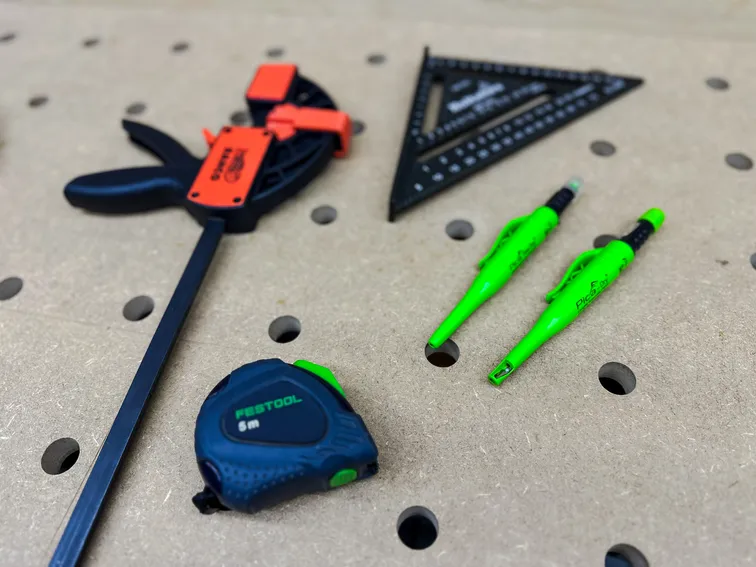
Image by:
hashtagsheepNow that we’ve covered how to protect your eyes, ears, lungs, and fingers, it’s time to talk about the gear that brings your projects to life.
This post is all about the unsung heroes of woodworking, the gear you’ll grab for nearly every project. From marking and measuring to clamping and setting up a stable work surface, these essentials form the backbone of any hobby workshop.
Marking tools
Pencils are the first thing you’ll need for almost any woodworking task. My go-to recommendation is a mechanical pencil. Unlike traditional ones, you don’t need to constantly sharpen them to keep a clean, thin line. You can find them at any store with school or office supplies (usually for 1-2 EUR/USD). Grab some extra leads while you’re at it, wood can be rough on them.
There are also specialized marking pencils, like those from Pica. These are designed for professionals and work on almost any material. They include features aimed at jobsite convenience, such as built-in sharpeners and better grip when wearing gloves. They also come in various colors and lead types, which is especially helpful when working with darker woods, tricky lighting, or unusual materials. They’re a bit of an investment (around 15 EUR/USD), but one that pays off if you do a lot of marking or often work in less-than-ideal conditions.
You might also hear people talk about marking knives. These are super accurate tools used to mark crisp, clean layout lines, especially helpful for joinery. But as a beginner, I’d hold off. They’re not expensive, but they’re more of a precision tool for later down the line, once you’re comfortable with basic layouts and want to improve accuracy.
Also worth mentioning: carpenter pencils. These are thick, oval-shaped pencils that won’t roll away and are great for rough work or marking on dusty and dirty surfaces. However, they’re not ideal for precise marking since the tip wears down quickly unless you sharpen it often (and with a knife, not a regular sharpener). Because of that, I wouldn’t recommend them for general use in a woodworking workshop.
Measuring tools
There’s a surprising variety of tools and techniques for measuring in woodworking, it’s a rabbit hole all of its own and will get its own blog post soon. But for now, a few essentials will do the trick:
- Tape measure: One of the most versatile and most-used tools in any workshop. Don’t overdo it with the length, you don’t need a 10-meter tape for building a bookshelf. A compact 3-5 meter model from a reliable brand is accurate, durable, and has a fair price (around 10-15 EUR/USD).
- Speed square: Also sometimes called rafter square, this compact triangle is more versatile than it looks. It helps mark accurate 90° and 45° angles, includes notches for drawing parallel lines, and even works as a quick saw guide. A 15-20 cm (6-8 inch) model covers most needs. Solid options are available from local manufacturers like Hultafors (starting at 15 EUR/USD) or international brands like Empire (around 15-35 EUR/USD).
Just a heads-up: high-end versions of these can get pricey fast. They’re beautifully made, incredibly precise, and often come with clever or unique features that solve common workshop headaches. But for beginners, they’re usually total overkill… you’ll get more value putting that budget elsewhere.
Also worth having: something that functions as a long straight edge. This could be a steel ruler (starting around 10 EUR/USD) or a longer sturdy level with a sharp edge (usually from 30 EUR/USD). Both double as great marking guides and are super useful for checking flatness, especially on longer boards or surfaces.
Clamps
Ah yes, clamps. Another rabbit hole.. and yes, I’ll write a dedicated post on this too.
For starters, go with quick clamps (also called one-hand clamps). They’re available in a wide range of lengths: short ones for small boxes, longer ones for panels and frames. Some models come with clever features like reversible heads (to switch between clamping and spreading) or rotating jaws for odd angles. Super versatile, and great for almost any beginner project. I’d recommend starting with four, that’s usually enough for small to medium projects. My most-used size is 30 cm (12 inches). Don’t buy the absolute cheapest ones, they often use softer steel, which can cause the clamps to flex or get stuck. Others don’t apply enough pressure, or worse, they might suddenly spring open when you least expect it. Spending a bit more for a reputable brand like Bessey or IRWIN is absolutely worth it (starting at 15 EUR/USD).
There’s a saying: you can never have too many clamps. That’s definitely true when it comes to owning them… I’ve yet to hear anyone complain about having extra clamps lying around. But when you’re actually applying pressure, too much clamping force can do more harm than good. More on that in the mentioned future post, where I’ll go into types of clamps, how to apply the right amount of pressure, and a few tips on getting it just right. For now, just remember: tight is good, but tighter isn’t always better.
Also worth mentioning: if someone in your family or circle still has some old handscrew clamps or wooden clamps, ask if you can adopt them. They’re still incredibly useful for delicate or oddly shaped workpieces.
Work surface
You need a stable surface where you can stand upright and work safely. Good posture isn’t just about comfort, it helps you apply force in a controlled way, reduces fatigue, and lowers the risk of injury, especially during repetitive tasks. A proper working height also makes it easier to measure and work accurately.
On top of that, a solid and flat work surface gives you a reliable base for clamping, which is essential when assembling or gluing up projects. If the table wobbles, flexes, or isn’t straight, your clamps won’t hold properly, and that can lead to frustration, misaligned parts, or glue-ups that twist out of shape.
Here are a few common options, from basic setups to more advanced systems:
- Go with what you’ve got: An old table works fine, as long as it doesn’t wobble and has a surface where you can clamp things down.
- DIY route: The simplest option? Four basic table legs (around €10 EUR/USD each) and an edge-glued board or kitchen-style benchtop (starting at 30 EUR/USD per meter). That’s enough to create a solid and reliable surface to get started. From there, you can go all-in on upgrades and custom builds: your space, budget, and willingness to tinker are the only limits. There’s no shortage of creative ideas on YouTube if you’re looking for inspiration.
- Folding workbench: These compact benches often come with a small clamping surface and foldable legs, making them easy to store and set up. They’re widely available in construction stores or hardware chains and offer great value for hobby workshops. Entry-level models start at a reasonable price (around 50 EUR/USD), but options from well-known tool manufacturers can climb quickly in cost, especially if they include built-in clamping systems, better stability, or modular add-ons.
- Mobile workstations: Brands like Ryobi, Kreg, and Festool offer more advanced all-in-one solutions with built-in clamping systems, cutting guides, tool storage, and expandable surfaces. The price tag can cause a bit of lightheadedness, but they’re incredibly useful, especially if you’re working in a smaller space like I am or want a flexible mobile setup.
- Full workbench systems - Drawers, vises, dog holes… and a hefty price tag. These are fantastic if you have the space and budget, but not something most beginners need right away. That said, I’d actually recommend building one yourself at some point, it’s a great learning project, and small imperfections won’t matter. You’ll gain experience, and end up with a system tailored to your workflow and space.
Other essentials
It’s worth picking up a small set of standard hand tools to cover basic tasks. You don’t need anything fancy, but these come in handy more often than you’d think. You can often find starter kits that bundle these tools together (around 40-80 EUR/USD). They don’t have to be pro-grade, just solid, reliable, and ready when you need them.
- Hammer: For small assembly tasks or tapping joints into place. Nothing too heavy or special, just a basic claw hammer will do.
- Screwdrivers: A mix of flathead and Phillips. A multi-bit driver can save space (and lets you share bits with your drill/driver).
- Allen keys (hex keys): Commonly needed for assembling furniture or making adjustments on machines.
- Wrenches or small spanners: For bolts, nuts, and tool tweaks. A basic adjustable wrench is fine, but if you want something smoother and quicker, look at ratcheting spanners (click-style wrenches) or a combination wrench set with open and box ends.
Now that we’ve got the basics out of the way, let’s look at a few other low-key MVPs of the workshop:
- Masking tape: Seriously, you’ll use it constantly. Great for layout, marking, labeling, temporary assembly… all sorts of stuff (less than 5-10 EUR/USD).
- A deck of playing cards: Sounds silly, but they make perfect adjustable spacers. Grab an old deck or buy a cheap one you don’t mind getting dusty (less than €1 EUR/USD).
- Utility knife / box cutter: Super handy for opening packaging, trimming materials, or cleaning up small edges (starting at 5 EUR/USD).
- Sandpaper: Essential for smoothing edges, prepping surfaces, or breaking sharp corners. A mixed pack or single sheets of various grits from 80 to 240 will last a while (around 5-10 EUR/USD).
Chisels, hand saws, and other sharp objects
For now, I’m skipping these. They can be great additions to your toolbox (or make a nice gift from a loved one) as you go. Using them can be a lot of fun, deeply satisfying, and a great way to level up your skills, but right now, I want to keep things minimal, both in terms of learning curve and budget.
Don’t worry, we’ll talk about them later in the series.
Consumables
Things like screws, nails, glue, and dowels should be bought per project. There’s no universal size or type for everything, and overstocking too early will just waste space (and money).
We’ll go deeper into joinery options and supplies in a future post, but for now, just grab what you need when you need it.
Up next
You’ve got your measuring tools, clamps, and a sturdy surface to work on: now it’s time to bring in some power. In the next post “Let’s go shopping: power tools”, we’ll look at the first electric tools to add to your setup, from drill drivers to sanders and saws.
Happy shopping… and don’t blame me when your wishlist explodes!
Explore the series:
- Woodworking 101 - Part 1 - Getting powered up
- Woodworking 101 - Part 2 - Let's go shopping: protective gear
- Woodworking 101 - Part 3 - Let's go shopping: workshop essentials
- Woodworking 101 - Part 4 - Let's go shopping: power tools
- Woodworking 101 - Part 5 - Let's talk wood: materials you'll meet
I hope you enjoyed the read, and if not, that's fine too! Feel free to share your thoughts or reach out on Instagram, Mastodon, Bluesky or MakerWorld. I'm always happy to hear feedback: good, bad, or sheep-themed.